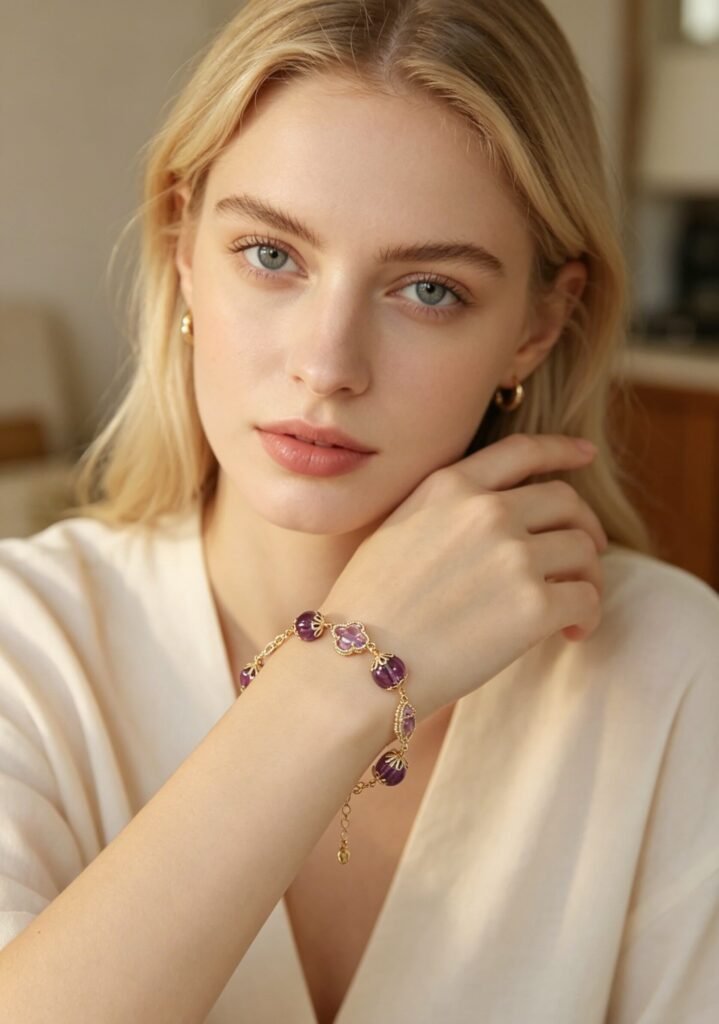
A bracelet becomes part of your day through small details: the way it rests beside a sleeve, moves when you reach for a cup, or feels while you type. A comfortable fit helps a meaningful piece become something you actually enjoy wearing.
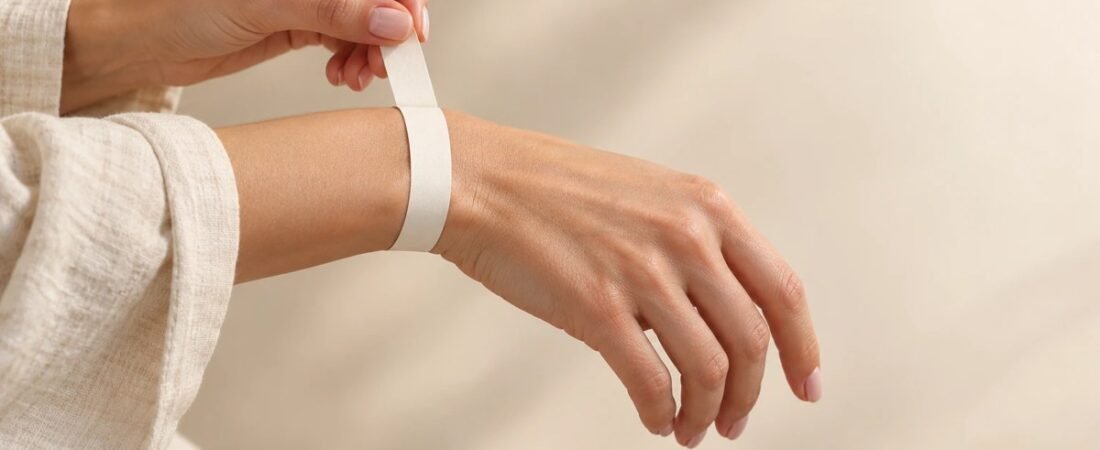
To measure bracelet size for women, begin with the circumference of the wrist where the bracelet will sit. Use a flexible tape or a strip of paper, keep it close to the skin without squeezing, and record the measurement. Then follow the size guide for the particular bracelet. Your wrist measurement is the starting point, rather than an automatic order size.
This guide separates wrist size from bracelet length, explains what changes with beaded designs, and gives you a practical way to check fit before ordering.
Measure your wrist in five simple steps
You need a flexible measuring tape, or a narrow paper strip, a pen and a ruler. Avoid elastic cord, which can stretch and change the reading.
- Choose the wrist on which you intend to wear the bracelet. Rest your hand in a relaxed position.
- Place the tape around the part of the wrist where the bracelet will sit, usually close to the wrist bone. If the maker specifies a measuring position, follow that instruction.
- Let the tape touch the skin all the way around without digging in. Do not add space at this stage.
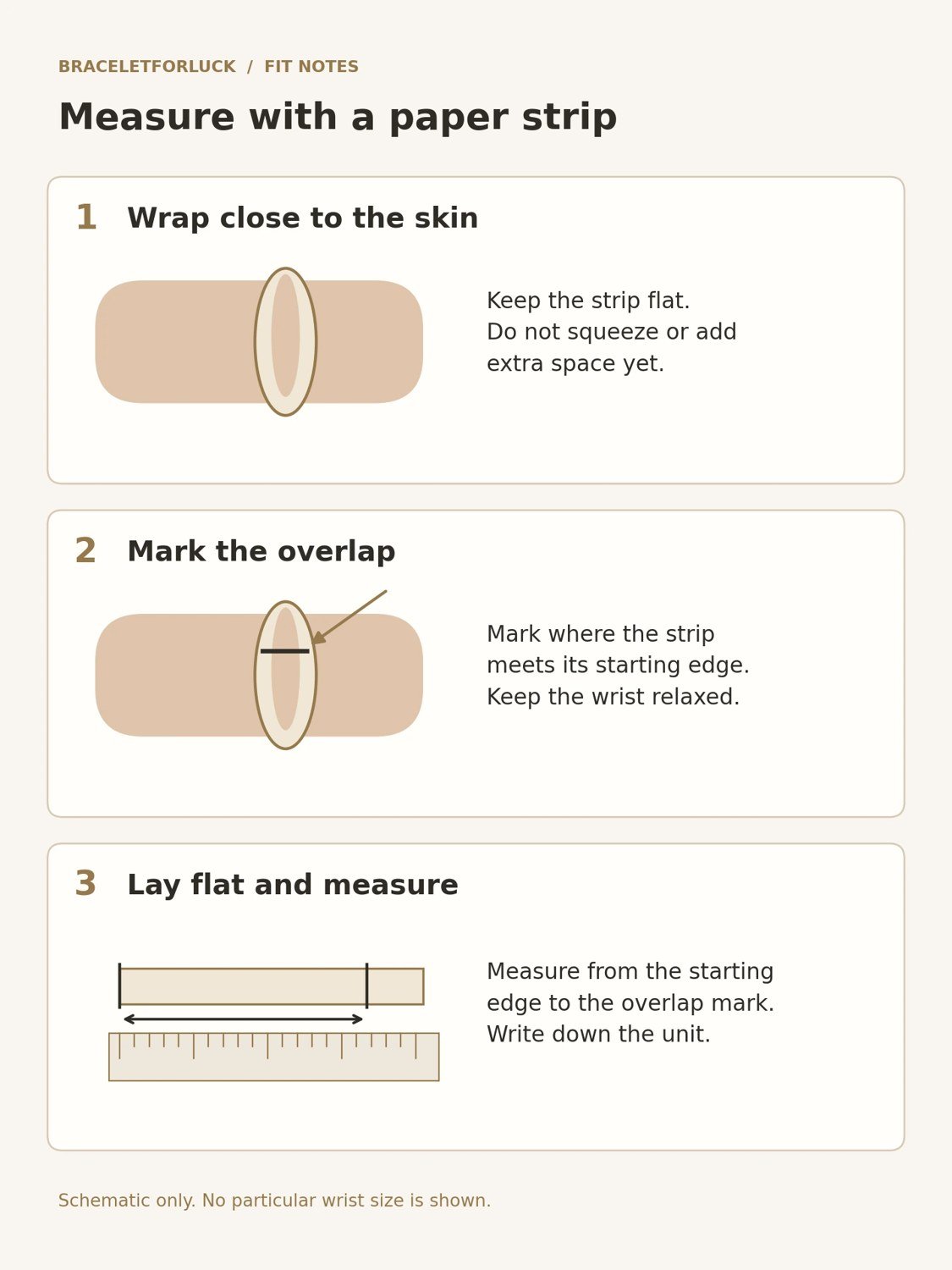
- Read the measurement where the tape meets its starting point. With paper, mark the overlap, lay the strip flat and measure from the starting edge to the mark.
- Repeat once to check your reading. Write down the wrist measurement and the unit used.
If you plan to switch wrists, measure both. Small differences can matter when a design has a narrow fit range. For help deciding which side suits your routine, read Which Wrist Should You Wear a Crystal Bracelet On?.
Convert inches and centimeters without changing the meaning
One inch equals 2.54 centimeters. Multiply inches by 2.54 to obtain centimeters, or divide centimeters by 2.54 to obtain inches.
| Measured wrist circumference | Approximate equivalent |
|---|---|
| 5.5 inches | 13.97 cm |
| 6 inches | 15.24 cm |
| 6.5 inches | 16.51 cm |
| 7 inches | 17.78 cm |
| 7.5 inches | 19.05 cm |
| 8 inches | 20.32 cm |
This is a unit-conversion table, not a Braceletforluck product size chart. It does not assign Small, Medium or Large, and it does not add room for movement. Use the original measurement when checking a product’s stated range, especially near a size boundary.
Wrist size, bracelet length and inner circumference
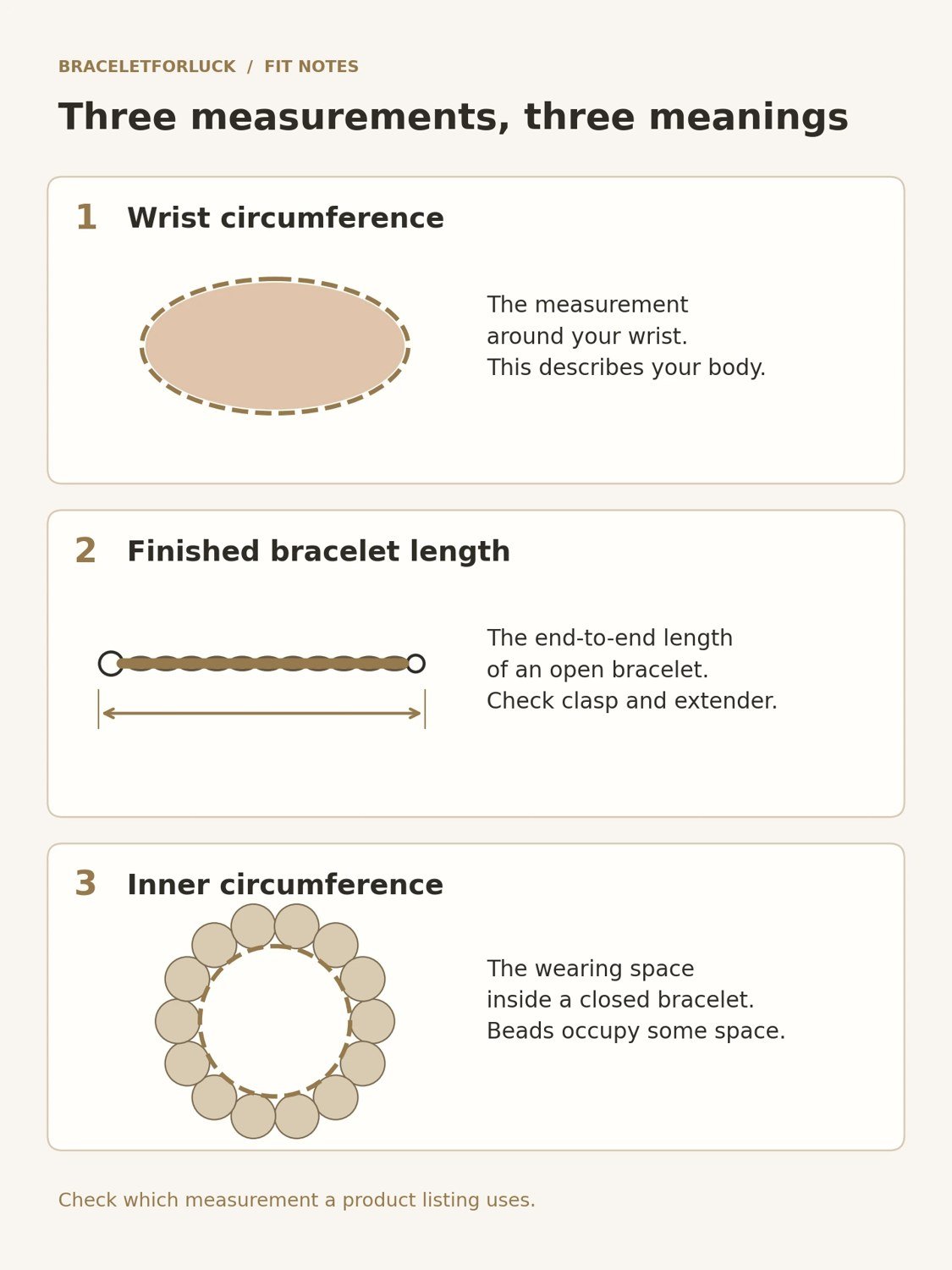
These measurements answer different questions.
Wrist circumference measures your body. A listing that says “fits wrists from…” should be compared with that measurement, following any instructions about fit preference.
Finished bracelet length usually measures the piece itself, often laid straight for an opening chain. Check whether the seller includes the clasp and whether an extender is listed separately.
Inner circumference describes the wearing space inside a closed bracelet. It can be especially useful for beaded pieces, where the beads take up space between the stringing path and the wrist.
For illustration, adding a hypothetical 1.5 cm allowance to a 16 cm wrist gives 17.5 cm. That arithmetic does not establish the correct size for a particular bracelet. Its construction and the maker’s measuring method still matter.
Before ordering, ask: “Does this number describe the wrist it fits, the finished length, or the inner circumference?”
Choose the measuring method for the bracelet type
Chain and clasp bracelets
A fine chain generally needs room to move rather than being held taut against the wrist. Follow the allowance recommended for that design. A charm-heavy bracelet may need a different fit from a simple chain.
Confirm the usable length, clasp arrangement and any extender range. An extender shown in a photograph should not be treated as included unless the listing says so.
Beaded and stretch bracelets
A bead strand’s outside measurement is not its usable inner space. Larger beads can change how a bracelet sits even when two strands have a similar stated length.
Ask for the recommended wrist range, bead diameter and whether the stated size was measured stretched or unstretched. Elasticity helps a bracelet pass over the hand; it does not establish an unlimited wearing range. A bracelet that must remain heavily stretched to sit on your wrist needs a fit check.
Adjustable cord bracelets
Check both the wearing range and how widely the bracelet opens. An adjustable loop still has to pass over the hand unless its construction opens completely.
Ask how the closure works and whether its range describes the wrist or the cord. “Adjustable” alone does not tell you whether the bracelet will fit.
Rigid bangles and cuffs
A closed bangle must pass over the hand, so wrist circumference alone may be insufficient. Use its maker’s hand-measurement and internal-diameter instructions.
A cuff has different considerations, including its opening and shape. Follow the design’s instructions rather than bending it to create extra room.
Check comfort against your actual routine
Think about when you will wear the piece. A bracelet for typing at a desk may feel better with less movement than one chosen for an evening outfit.
When trying it on, move your wrist gently, reach for an object and let your arm rest at your side. The piece should feel secure without squeezing. Notice whether a clasp presses against your skin, a centerpiece keeps rotating underneath, or beads interfere with a watch.
A finger-space check may help with some chains, but it is not a universal test for every construction. If a bracelet feels restrictive or slides off too easily, revisit the size rather than relying on its label.
For stacking, try the combination together. A watch, several strands and a shirt cuff share a small amount of space, and each piece should remain comfortable.
Buying a bracelet as a gift
The most useful information is the recipient’s measured wrist size and preferred fit. Ask which wrist they usually wear jewelry on and whether they like a close or gently moving bracelet.
A bracelet they already own can provide a reference if the construction is similar and you know how its length was measured. A chain’s laid-flat length will not automatically translate to a beaded bracelet’s size.
Before choosing a gift, confirm the actual fit range, available size options, current return terms and what packaging is included. Read How to Give a Feng Shui Bracelet as a Meaningful Gift for a broader giving checklist.
Bring your measurement to the product page
If you are drawn to a dark beaded style, explore the Black Obsidian Wealth Bracelet. Its listing identifies black obsidian and gold-plated components. Ask us to confirm its current wrist-fit range and bead dimensions before choosing it for a particular measurement.
You can make the question specific: “My wrist measures 16 cm where I wear a bracelet, and I prefer gentle movement. What wrist range does this piece fit, and how was it measured?”
At Braceletforluck, our perspective on meaningful jewelry is rooted in Foshan and inspired by Xiqiao Mountain and Guanyin culture. That connection gives space to care, reflection and personal symbolism. Choosing a comfortable fit is a practical part of bringing a meaningful piece into everyday life.
Explore the Braceletforluck collection, keep your wrist measurement nearby, and confirm the details of the piece you love before ordering.
Frequently asked questions
How do I measure my wrist without a tape measure?
Wrap a narrow strip of paper around the wrist where you plan to wear the bracelet. Mark where the ends meet, lay the strip flat and measure from its starting edge to the mark with a ruler. Keep it close to the skin without pulling it tight.
How much bigger should a bracelet be than my wrist?
There is no single allowance for every bracelet. Follow the size guide for the specific design and check whether its measurements describe wrist size, finished length or the inner wearing circumference. Chain, beaded, adjustable and rigid bracelets can require different sizing methods.
What bracelet size should I choose for a 6-inch wrist?
A 6-inch wrist measures 15.24 centimeters. Treat that as your wrist measurement, then compare it with the selected bracelet’s stated wrist-fit range or design-specific size guide. It does not automatically mean you should order a bracelet labeled 6 inches.
Do larger beads affect bracelet fit?
Yes. Beads occupy space toward the wrist, so a strand’s outside measurement or string length does not directly describe its inner wearing space. Ask for the recommended wrist-fit range or inner circumference, together with the bead diameter, before choosing a size.
Measurement references
For additional guidance, see the Tiffany & Co. bracelet size guide, James Avery’s bracelet sizing guide and Pandora’s bracelet-specific sizing guidance. Their size labels and allowances apply to their respective designs; use the instructions for the bracelet you are considering.