
The meaning of evil eye bracelet colors cannot be reduced to one universal chart: the history of a motif, a maker’s interpretation and your own color preference can be different things. Blue nazar imagery has a documented cultural setting, while many contemporary palettes reflect design choices or personal associations. This guide helps you compare the colors, understand the context and choose a piece thoughtfully.
What does the evil eye symbol mean?
The “evil eye” is a belief found in different cultural contexts that envy or a harmful gaze can bring misfortune. People in some communities wear or display amulets as symbols connected with protection from that gaze. The history and use of a symbol depend on its place and community, so a single explanation should not be applied to every eye-shaped design.
For example, the Museum of European Cultures at the Staatliche Museen zu Berlin describes the nazar boncuk, or “blue eye,” as an amulet associated with protection from envy and jealousy, now widespread in Turkey and other Muslim regions. The museum’s collection also presents other amulets with distinct religious and local contexts. These examples help explain why “evil eye” jewelry does not have one universal history or interpretation. See the museum’s overview of objects in its collection.
Evil eye bracelet colors and meaning
People often search for a fixed chart that assigns one meaning to every bead color. There is no single color key shared by all regions, traditions, or jewelry makers. If a seller gives a specific color interpretation, look for the cultural context behind it rather than assuming the explanation applies to everyone.
Blue and white eye beads
Blue-and-white concentric eyes are a familiar visual form of the nazar bead. The Berlin museum identifies the nazar boncuk as a “blue eye” amulet associated with protective beliefs. This describes a cultural interpretation rather than a literal effect. Color alone does not establish a universal meaning, and a bracelet cannot guarantee safety or change what happens to its wearer.
Other colors and contemporary designs
Green, red, black, gold, and multicolored eye motifs may appear in contemporary jewelry. A maker or wearer might connect a shade with a personal memory, a local custom, or simply a preference in clothing and design. Those meanings can be personal or specific to a community; they are not a universal rule. Choose colors because you understand and enjoy the design, not because a chart promises a result.
Different objects can use eye imagery in different settings. Before repeating a meaning chart, ask whether it explains the design’s actual tradition or simply assigns a modern intention to a color. A meaningful choice can be personal without pretending to be universal.
Compare colors without a universal meaning chart
Use this as a guide to questions, not a fixed list of powers. The blue nazar has documented cultural context; other color interpretations need their own source. Your styling preference can be a valid reason to choose a shade without inventing a traditional explanation.
| Color or palette | Meaning to approach carefully | A practical styling question |
|---|---|---|
| Blue eye motif | The nazar boncuk has protective symbolism in particular cultural settings | Do I prefer one eye detail or a more visible layered piece? |
| Blue-green or turquoise tones | A contemporary palette may carry a wearer’s own memory or intention | Does it suit my usual blue, green or neutral clothing? |
| White or pale tones | A maker may give these colors a particular interpretation; ask for its context | Do I enjoy a light accent against a darker sleeve? |
| Black or dark tones | A personal association is different from a guaranteed protective effect | Will a dark piece work with my everyday accessories? |
| Red or warm tones | Color meanings vary; do not assume a relationship or confidence outcome | Do I want the bracelet to be the main color accent? |
| Gold tone or multicolored | Appearance does not establish metal content or combined spiritual effects | Which visible color do I want to echo elsewhere in the outfit? |
A quick way to decide on your color
- Look at the colors you already wear most often. Choose a matching tone or one deliberate contrast.
- Identify the eye detail separately from the surrounding beads. A blue-green bracelet need not have a blue eye centerpiece.
- Ask what the seller means by a color interpretation and whether it refers to a specific community, source or modern design story.
- Confirm materials and fit independently. Turquoise color does not establish turquoise stone; gold tone does not establish solid gold.
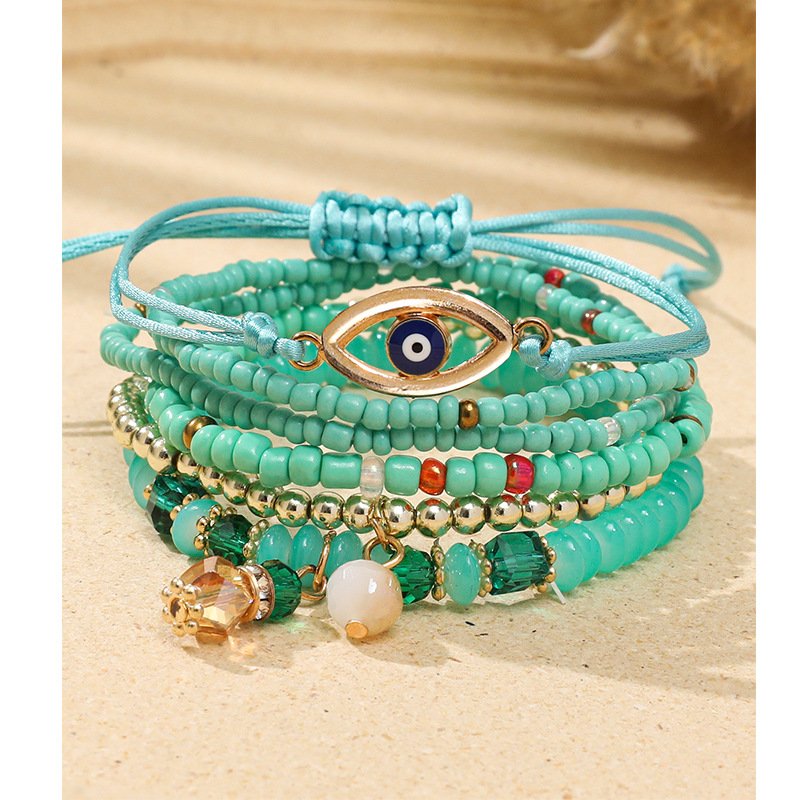
For the current BFL example, the Lucky Eye Bracelet shows layered blue-green strands and a gold-tone eye-shaped centerpiece. Its listing does not specify bead material, metal, size or adjustment. Choose its actual palette and ask for those details before ordering.
How to choose an evil eye bracelet
- Start with the design: Decide whether you like a single eye bead, a central charm, or a more decorative motif. Color and styling are personal choices.
- Read the cultural explanation: If the bracelet refers to a particular community or spiritual practice, look for a careful account of that context. Avoid assuming one meaning fits every person.
- Check materials and fit: Review the product listing for named materials, dimensions, closure, and adjustability. Do not infer those details from a photograph.
- Review care instructions: Follow guidance for the specific stones, metals, coatings, and cords. Water and cleaning products are not suitable for every piece.
- Keep expectations realistic: A bracelet can be jewelry, a keepsake, or a personal symbol. It cannot promise protection, health, wealth, or good fortune.
For gift questions, review fit, packaging and the current return terms for the specific item. You can share a personal wish in a note while leaving the recipient free to interpret the motif. Our bracelet buying checklist covers the practical questions.
How to wear and care for one
There is no wrist placement that applies to every wearer. Choose the side that feels comfortable, works with a watch, and suits your daily activities. If you follow a particular tradition, consult a reliable source from within that community instead of treating a popular online rule as universal. Our guide to choosing a wrist covers practical comfort and styling.
Care depends on the bracelet’s actual materials and construction. Follow the listing’s instructions; when details are missing, ask the seller before using water, heat, household cleaners, or ultrasonic devices. For general water-related questions, see our jewelry care guide.
Frequently asked questions
What do evil eye bracelet colors mean?
Meanings vary. Blue-and-white concentric eye beads are associated with some nazar traditions, while other colors may reflect a local interpretation, a maker’s explanation, or personal style. There is no one chart that applies to everyone.
What does a blue evil eye bracelet symbolize?
In some traditions, a blue nazar bead is connected with protection from envy or the evil eye. That describes a cultural or spiritual belief; wearing a bracelet does not guarantee literal protection or a particular outcome.
Does an evil eye bracelet protect you?
Some people wear the motif for its protective symbolism or personal meaning. A bracelet cannot guarantee safety or prevent harm, so use practical precautions for real-world risks.
Which wrist should I wear it on?
There is no universal rule. Choose the wrist that is comfortable, or follow guidance from a tradition that is meaningful to you.
Can I wear an evil eye bracelet every day?
That depends on its materials, fit, construction, and your activities. Follow the specific care guidance, and remove it when it could snag or be damaged.