The origins of Feng Shui are layered: this Chinese tradition concerns how people relate to place, landscape, and orientation. The name is commonly translated as “wind and water,” but its history is more layered than a single invention date or one unchanged system spanning all of Chinese history.
Historical scholarship describes related practices under different names and records their development across many periods. The term “Feng Shui” became common during the Song dynasty (960–1279), while earlier texts used terms such as kanyu, xiangzhai, and dili. Practices included choosing and orienting sites for buildings and tombs, with methods and interpretations changing over time.
What Does Feng Shui Mean?
“Feng” means wind and “shui” means water. In historical use, Feng Shui is often discussed alongside Chinese geomancy: ways of assessing a location, its landforms, and its orientation within a traditional cosmological framework. Historical accounts do not describe one universal formula used identically by every community.
Ole Bruun’s chapter on the history of Feng Shui from Cambridge University Press notes that related forms of divination appeared in early records under several names, while “Feng Shui” became common in the Song period. The University of Hamburg’s Centre for the Study of Manuscript Cultures also examines a manuscript connected with geomantic practices and tomb orientation.
Feng Shui Developed Over Time
It is difficult to assign Feng Shui one exact beginning. Some practices with similar concerns appear in early Chinese history, but early sources used different vocabulary and did not necessarily describe a single unified discipline. Over the centuries, practitioners drew on landscape observation, direction, cosmology, divination, and other bodies of thought.
The historical record also includes both residential and funerary settings. The balance between these applications shifted across periods. Later traditions developed different methods, including approaches that placed different weight on landform, direction, and compass-based calculations. A single online rule about a doorway, room, or wrist cannot stand in for that diverse history.
For additional historical context, see the scholarly overview of geomancy’s development across premodern East Asia in Transnational Asia.
Feng Shui in Modern Homes
Today, people may use Feng Shui when thinking about room arrangement, entrances, work areas, or the feel of a space. Specific advice differs among practitioners and schools. It is reasonable to treat these choices as cultural, aesthetic, or personal practices. Avoid presenting claims about qi or object placement as if they have been shown to determine wealth or personal outcomes.
A practical question can still be useful: does the space support the activity you want to do there? A clear work area may make it easier to find your materials; a comfortable chair may make a room more pleasant to use. Those are observable design choices, not proof that an arrangement controls life events.
Are Lucky Bracelets Part of Traditional Feng Shui?
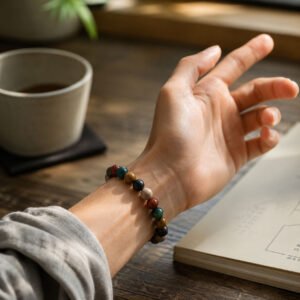
Historical sources discussed here focus on place, landscape, and orientation. They do not establish a lucky bracelet as a classical Feng Shui device. A bracelet today may still carry personal meaning: it can mark a milestone, represent a wish, or remind its wearer of a chosen intention. That modern symbolic use should be described as such, rather than presented as a documented historical method for controlling outcomes.
If you are considering a bracelet as a personal symbol, read our Feng Shui mindset guide and Gold Lucky Charm Bracelet meaning and gift guide. Check product pages for current materials, fit, and care details before buying.
Frequently Asked Questions
Does Feng Shui Have One Exact Start Date?
No single date captures the whole history of Feng Shui. Related practices have long histories, but the terminology and methods developed over time; the term “Feng Shui” became common during the Song dynasty.
What Does Feng Shui Literally Mean?
The name is commonly translated as “wind and water.” Historically, Feng Shui included practices concerned with sites, landforms, and orientation.
Does Feng Shui Guarantee Good Luck?
People may value Feng Shui within cultural or personal traditions, but an arrangement or piece of jewelry should not be promised to guarantee wealth, protection, or a specific outcome.
Are Lucky Bracelets an Ancient Feng Shui Tool?
Historical sources discussed here focus on site selection and orientation; they do not establish jewelry as a classical Feng Shui tool. A contemporary bracelet can carry personal symbolism.